A Written Cue or a Familiar Object? Choosing a Reminder You’ll Notice
Compare a written cue with a familiar object to choose a reminder that fits your setting, draws your attention, and is easy to act on.
The common mistake with a daily reminder is choosing one that is easy to set up but easy to overlook; the intended pause then slips past unnoticed. A written cue or familiar object can both bring attention back to an intention, but each works best where it can be seen without adding clutter or friction.
What makes a prompt easy to notice?
A useful prompt has two jobs: it catches your eye, then helps you remember what to do. A note can name the action directly. An object can stand out through its shape, texture, or place, but its meaning may take a moment to recall.
Noticeability is personal and depends on the setting. A bright sticky note may pop against a quiet desk and disappear into a wall crowded with messages. A smooth stone may be obvious on an empty windowsill but blend into a bowl of keepsakes.
Consider the prompt at the moment you need it, not only when you place it. Will your attention pass that spot naturally? Can you understand the cue while carrying groceries, opening a laptop, or waiting for the kettle?
When is a written cue the better fit?
Choose a written reminder when the intention needs specific wording, or when you want to change that wording as your needs shift. “Drop your shoulders” gives a clearer direction than a generic symbol; “take one quiet breath” is immediately understandable without an extra layer of interpretation.
A note is also handy in shared or temporary settings. A small card beside your keyboard can travel with a laptop, and a note inside a planner can prompt you in a library or meeting room without requiring a permanent display.
Keep the message brief and readable at a glance. Use an index card, sticky note, or note on a paper calendar. Put the cue near a routine you already encounter, but not where it blocks a screen, hides a needed item, or gets mistaken for another task.
Written prompts suit people who respond well to language and want a reminder they can revise. Their drawback is that familiar text can become visual background. If you repeatedly see the note without registering it, move it or change its wording rather than adding more notes nearby.
When can a familiar object do more?
An object can be a good prompt when words feel like another instruction to process. A small shell, wooden bead, or fabric square might invite a brief sensory check: notice its texture, then return to what you were doing with a little more awareness.
Objects can also work when a written message would feel conspicuous. A smooth pebble beside a home desk may look like decoration, while a message about pausing could draw unwanted attention in a shared office. Choose something you can leave in place without making a surface harder to use.
The trade-off is that an object can be ambiguous. If you forget what it is meant to remind you of, it may become decoration rather than a cue. Give it one clear association, and avoid assigning the same object several unrelated meanings.
A familiar object suits someone who remembers through touch, shape, or a meaningful association. It is less useful if the object is easy to pocket, move, or overlook amid similar items. You do not need to touch it for it to work; its visible presence may be enough.
Which prompt works in each setting?
At home, you can usually choose a visible spot and leave a modest object there. In a shared workspace, a discreet card or an item that belongs at your desk may be more appropriate. On the move, a cue attached to something you already carry can be easier to keep with you than a loose object.
Think about how long the prompt will stay in one place, who else uses that space, and whether you are comfortable with other people seeing it. A note can disclose a private intention; an object may be less revealing, though its meaning can still be personal.
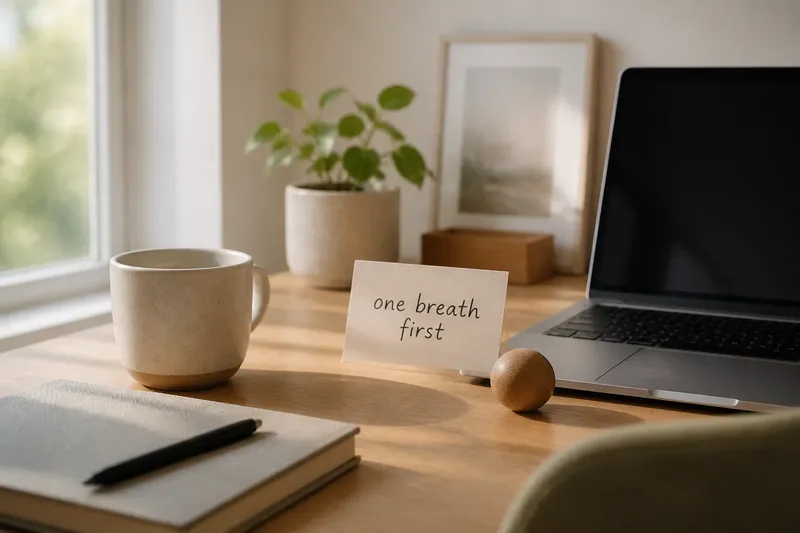
Imagine you want to remember to pause before opening your inbox. At home, you might place a small wooden bead beside the keyboard and let its presence call to mind one unhurried breath. In a shared office, you might instead tuck a card reading “one breath first” beside your trackpad, where you can see it without displaying it to the room.
What should you ask before choosing?
Do written reminders work better than visual objects?
Neither is universally better. Writing is clearer when the intended action needs words, while an object may suit a prompt you want to notice through its appearance or tactile character.
How can I stop a note from disappearing into the background?
Try a different location, a simpler message, or a note with a stronger contrast against its surroundings. If you still skip over it, remove it for a while instead of surrounding it with more reminders.
What if I forget what an object means?
Give the object one plain association and place it where that association makes sense. If the meaning keeps slipping, attach a short written cue or choose a prompt that is more direct.
Can I use both a note and an object?
Yes, if each has a distinct job: the object can catch your eye while the note supplies the action. Keep the pairing simple, since several competing cues can make the intended reminder harder to pick out.
How do you make a clear choice?
Start with the place and the kind of prompt you tend to register. Ask yourself:
- Will I naturally look toward this spot?
- Do I need exact words, or can an object remind me?
- Will the cue feel comfortable in a shared space?
- Could it be confused with a task, decoration, or another reminder?
- Can I keep it visible without getting in the way?
Choose one cue for one intention, then pay attention to whether you notice it and understand it. If it is repeatedly missed, change its position, wording, or form. There is no need to treat a forgotten prompt as a failure; it may simply be poorly matched to that setting.
For a written cue or familiar object, the strongest choice is the one that makes the next action legible at the right moment. Keep the reminder modest, give it a sensible home, and let its usefulness—not its charm—decide whether it stays.