A Five-Minute Listening Walk for Noticing Layers of Sound
A five-minute listening walk gives you a simple way to notice nearby and distant sounds, recover from interruptions, and return with steadier attention.
The common mistake on a five-minute listening walk is to hunt for silence. That turns passing traffic, a barking dog, or a rattling vent into obstacles, and the walk becomes a test you cannot pass. A better aim is to notice how sounds overlap, change, and fade while you move through an ordinary place.
You do not need a scenic route, special equipment, or perfect concentration. Choose a safe, familiar path, let your attention travel among different layers of sound, and use a simple cue to return when a noise or thought pulls you away. The point is not to hear everything; it is to meet the sounds that are here.
Where does a listening walk fit?
Pick an occasion when a short walk is already possible: between errands, after closing your laptop, or during a break near home or work. A listening walk can happen on a quiet residential block, around a courtyard, along a public path, or in a garden. Familiar ground leaves more attention available for listening.
Before you set out, decide what the walk is for. You might want a change of pace after a screen-heavy task, a moment outdoors before going inside, or a way to pay attention during a route you already take. Naming the occasion gives the walk a natural beginning and end without adding a complicated routine.
Choose a route that lets you walk comfortably and notice your surroundings. Keep the phone put away if you can, but carry it if you need it for ordinary safety or communication. Do not close your eyes, wear sound-blocking headphones, or stop where you would obstruct other people. Traffic and other hazards deserve your attention first.
How can you begin without making a production of it?
At the starting point, pause for a moment and let your pace settle. Notice the surface underfoot and the general sound around you. There is no need to label each sound or take a deep breath on command; simply allow the walk to begin.
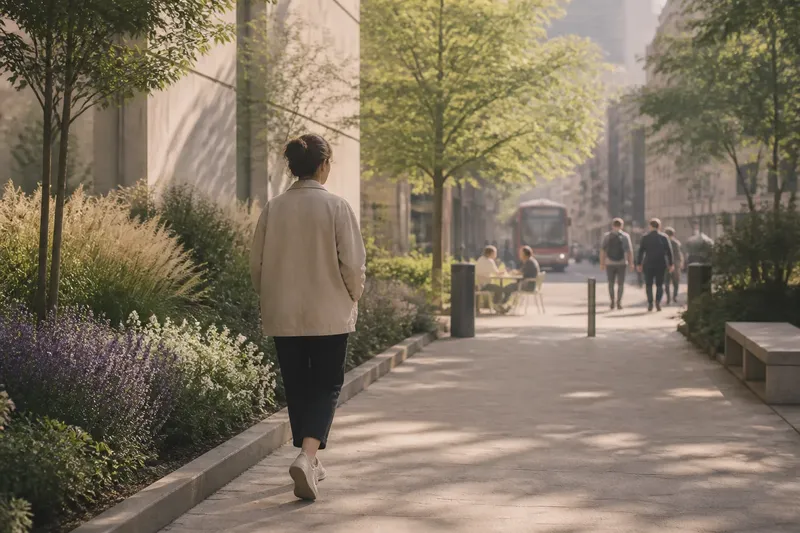
For an invented example, imagine you are leaving a shared office courtyard after a demanding meeting. You choose a familiar path beside a planted border, put your phone away, and start at an unhurried pace. You expect to notice a changing mix of footsteps, leaves, voices, and street noise, then return to the doorway ready to continue your day—not to achieve a particular mood.
If you like a time boundary, use a quiet timer set before you leave, or choose a landmark that marks the turn back. A timer is optional; checking a screen repeatedly would pull attention away from the walk. The route itself can be the cue: walk to the end of the block and return, or circle the courtyard once.
What sound should you listen for first?
Begin with the broadest layer: the general soundscape rather than one particular source. You might notice a wash of wind, traffic, rain, ventilation, or many voices blending together. Let that background be present without trying to decide whether it is pleasant.
Then listen for a sound nearer to you. It could be your shoes on gravel, a gate moving, a bird calling from a nearby tree, or water running through a downspout. Notice its texture—crisp, soft, uneven, continuous—without needing to identify its exact cause.
Next, allow your attention to reach farther away. A bus braking beyond a row of buildings or a conversation across a courtyard may arrive less clearly than the sounds close by. You are not trying to locate a source with certainty; you are noticing that some sounds seem near and others seem distant.
Let these layers sit together: broad background, nearby detail, and something farther off. Sounds may overlap, disappear, or trade places as you move. If one catches your interest, listen for a little while, then make room for the rest of the scene again.
How do you return after an interruption?
A listening walk will not stay uninterrupted. A loud truck may cover everything else; someone may greet you; your mind may jump to a message you need to answer. None of that means the walk has failed. An interruption is simply the next thing to notice.
First, respond to what needs a response. Greet the person, move away from a hazard, or pause where it is safe. When you are ready to resume, notice one sound that is available now: perhaps a shoe scuff, a bird call, or the soft wash of the street. That becomes your point of re-entry.
If a sound is too intense or uncomfortable, do not force yourself to stay with it. Shift your attention to a gentler sound, the feel of your steps, or the path ahead, and change direction if that feels sensible. Listening is an invitation to notice, not a demand to tolerate every sound.
What can make listening easier?
- Choose a familiar route. A path you already know reduces the need to plan each turn while you listen.
- Keep a comfortable pace. Move slowly enough to notice changes, without turning the walk into a performance.
- Leave room for ordinary noise. Passing cars, voices, and machinery are part of the soundscape, not distractions you must eliminate.
- Use one brief return cue. After an interruption, notice a sound that is present now and continue from there.
- Keep the phone out of your hand. If you need it for safety or access, keep it available without using it as a listening tool.
- End at a natural landmark. A doorway, bench, corner, or garden gate can signal that the walk is complete.
For route choice, accessibility, and any setting-specific restrictions, follow local guidance and the instructions that apply to your situation. The simplest route is the one that lets you move safely and comfortably.
What if the place is busy, quiet, or indoors?
A busy street can make the broad background obvious, but you may need to choose a less crowded sidewalk or courtyard to hear softer details. Keep your attention wide enough to notice people, bicycles, and vehicles moving around you. The walk should never require ignoring your surroundings.
A quiet place does not have to provide a dramatic sound. You might hear a sleeve brush against a coat, leaves shifting, or your own footsteps changing from pavement to packed earth. If nothing stands out, notice the quiet as a texture, with small sounds appearing and fading within it.
If going outdoors is not workable, a safe indoor corridor, covered walkway, or shared building courtyard may offer a short route. Listen for sounds near and far without disturbing others or entering private spaces. The practice depends on attention to layers, not on a particular landscape.
How do you finish and return to your day?
When you reach your chosen endpoint, let your pace ease and notice the sound around that place. You can take a moment to hear how the scene differs from where you started, or simply recognize that the walk is over. There is no need to grade your focus or remember every sound.
Before moving on, choose one ordinary sound to carry into the next activity: a door closing, leaves in the wind, or footsteps on the floor. Then turn toward what comes next. This small bridge keeps the walk connected to the day without asking you to hold onto a special state.
What do readers often ask about a listening walk?
Do I need to walk for exactly five minutes?
No. Five minutes is a convenient frame, not a requirement. If time is short, listen for a few moments on a route you already take; if you have longer, continue only while the walk remains comfortable and practical.
Should I listen to music or a guided recording?
For this particular walk, leave audio playback off so you can hear the place around you. If you need a recording for access or another personal reason, adapt the practice to your needs and keep enough awareness for your surroundings.
What if my thoughts keep taking over?
Notice that your attention has wandered, then choose one sound that is present now. You do not have to clear your mind before listening; returning is part of the walk.
Can I take a listening walk with someone else?
Yes, if you agree on a quiet stretch or a simple way to share the time without needing to talk throughout. You can also walk together and each notice sounds privately, then exchange one detail at the end if both of you want to.
How can you keep the practice light?
Let the route and soundscape change from one occasion to another. A wet sidewalk may bring out the tap of shoes; a courtyard at dusk may make distant voices more noticeable. Those details are enough—there is no need to collect them or turn each walk into a lesson.
A five-minute listening walk works best as a small, repeatable invitation: begin on familiar ground, notice broad and close sounds, let distance enter the picture, and return gently after interruptions. When you reach the end, take the ordinary sounds of the next place as they come. The next walk can begin whenever a short stretch of moving and listening fits your day.